MG Engine Swaps Forum
Inexpensive Fuel Injection
Posted by 1744







 |
Topic Creator (OP)
Jan 24, 2019 01:13 PM
Top Contributor
 Joined 19 years ago
6,797 Posts
|

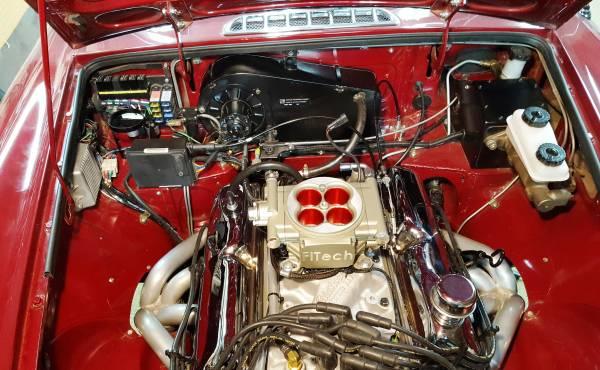
Attended a great even last week. At this event they had several vendors, one of the vendors was FITech
They had an engine running with a carb. Took the carb off and installed one of their unts on a SBC crate engine 190 hp
Simple installation, two wires, fuel lines including a return fuel line, fuel pump and filter.
Little hand held computer, they choose how many cylinders, ci's hp etc...
Engine was started, three to four revolutions and started and idle rough. Engine ran for a few minutes and started to smooth out until it was smooth idling. Self learning system.
It was amazing, and the cost very affordable $995 with everything.
I had to asked about the V6 3.4 liter, the answer was yes it works. The engine has to have 100 to 400 hp to work properly.
Trying to make a deal with them so that CCE can offer the FITtech FI
Keep in mind that this set up does not control ign timing. It is a great way to replace a carb.
They had an engine running with a carb. Took the carb off and installed one of their unts on a SBC crate engine 190 hp
Simple installation, two wires, fuel lines including a return fuel line, fuel pump and filter.
Little hand held computer, they choose how many cylinders, ci's hp etc...
Engine was started, three to four revolutions and started and idle rough. Engine ran for a few minutes and started to smooth out until it was smooth idling. Self learning system.
It was amazing, and the cost very affordable $995 with everything.
I had to asked about the V6 3.4 liter, the answer was yes it works. The engine has to have 100 to 400 hp to work properly.
Trying to make a deal with them so that CCE can offer the FITtech FI
Keep in mind that this set up does not control ign timing. It is a great way to replace a carb.
Member Services:
MG Classic Conversions V6. Wilwood brake dealer.
|
critchy
Dan Critchfield
|
Jan 24, 2019 02:40 PM
Joined 8 years ago
69 Posts
|

twentyover
Greg Fast
Lives in SoCal, Moving back to ancestral homeland, the Pacific NW, USA
 Sign in to contact
|
Jan 24, 2019 03:24 PM
Top Contributor
 Joined 20 years ago
5,409 Posts
|
 |
Jan 24, 2019 03:59 PM
Top Contributor
Joined 21 years ago
17,758 Posts
|
|
|
Topic Creator (OP)
Jan 24, 2019 04:52 PM
Top Contributor
Joined 19 years ago
6,797 Posts
|
In reply to # 3879935 by critchy
Bill,
i have looked at this company as well. did you see the 2 barrel version they now offer? i am using a 2.8L intake with a Holley 350cfm 2 barrel. i was thinking about using their 2b version.
i have looked at this company as well. did you see the 2 barrel version they now offer? i am using a 2.8L intake with a Holley 350cfm 2 barrel. i was thinking about using their 2b version.
Yes, the barrel is the prefer one fr the smaller engines. It's abut the same size as a two barrel carb. Could be taller, not sure.
The 4 barrel is a 1/4" shorter than a carb.
They do have units that control timing, but are for higher hp engines. This company was the first one to come out with this FI.
Used to be called Professional bla bla. Sold the rights for everyone else to make.
All of the parts such as throttle positioning and Air idle control are GM units, injectors are GM.
FITech is under new management so I was told. The ones I have seen at coffee and cars, owners are happy with their units.
Yes I would talk to them before buying. One area were it does not work well is on inline six cylinder, intake manifold is the problem.
So I was told.
I am going to give it a try on my 302 engine, yes it will have timing control and it works with either MSD or HDI distributor.
They have several models and a tri power unit.
Member Services:
MG Classic Conversions V6. Wilwood brake dealer.

Mustangsix
Jack Collins
|
Jan 24, 2019 09:15 PM
Top Contributor
Joined 14 years ago
6,390 Posts
|
I've been looking at the 2bbl version for a different application and it will control timing with a distributor that has a magnetic pickup like an HEI, Duraspark, or MSD.
Curious why they say inline six is an issue. There are manifolds that will accommodate 2 or 4 bbl for several engines and TBI has been done before.
Edited 2 time(s). Last edit at 2019-01-24 09:17 PM by Mustangsix.
Curious why they say inline six is an issue. There are manifolds that will accommodate 2 or 4 bbl for several engines and TBI has been done before.
Edited 2 time(s). Last edit at 2019-01-24 09:17 PM by Mustangsix.
 |
Jan 24, 2019 10:22 PM
Top Contributor
Joined 17 years ago
2,875 Posts
|

 |
Jan 25, 2019 07:16 AM
Top Contributor
Joined 19 years ago
20,902 Posts
|
I've installed 3 FiTech systems, and YES they do offer ignition control for another $200 upgrade. The self learning is SLOW, but it works. 2 years after my first installation, the car is still getting more powerful and faster.
As for tech support, one of their employees has documented every nuance of tuning their system online. Its typed out in a way that anyone can understand, if you have a few minutes to look it up. Its far better documented than any other brand, and far more tunable than it appears on the surface.
The FiTech isn't really $995 - that only gets you the basic kit - not a running car. It'll cost you between $1300-1500 for a DIY complete install. You'll need to add a quality fuel pump, air cleaner, fuel lines, fuel fittings, wiring, and a better Delco coolant temp sensor as the one in the kit is skewed. Its also a good idea to weld in a real O2 sensor bung as compared to what's included in the kit - another $1 from a local exhaust shop. If you have an application where you can buy an EFI fuel tank (from a company like TanksInc.com) the install can be knocked out in as little as 4 hours and you have a running, driving car.
I don't know about the newest rendition, but FiTech had major issues with their fuel command center, so stay away and simply modify your existing fuel system to accept a high pressure genuine Walbro pump. My next install will be the 2bbl system to see if that plays out as well as the 4 bbl system.
jeff@advanceddistributors.com
As for tech support, one of their employees has documented every nuance of tuning their system online. Its typed out in a way that anyone can understand, if you have a few minutes to look it up. Its far better documented than any other brand, and far more tunable than it appears on the surface.
The FiTech isn't really $995 - that only gets you the basic kit - not a running car. It'll cost you between $1300-1500 for a DIY complete install. You'll need to add a quality fuel pump, air cleaner, fuel lines, fuel fittings, wiring, and a better Delco coolant temp sensor as the one in the kit is skewed. Its also a good idea to weld in a real O2 sensor bung as compared to what's included in the kit - another $1 from a local exhaust shop. If you have an application where you can buy an EFI fuel tank (from a company like TanksInc.com) the install can be knocked out in as little as 4 hours and you have a running, driving car.
I don't know about the newest rendition, but FiTech had major issues with their fuel command center, so stay away and simply modify your existing fuel system to accept a high pressure genuine Walbro pump. My next install will be the 2bbl system to see if that plays out as well as the 4 bbl system.
jeff@advanceddistributors.com
|
|
Jan 25, 2019 07:46 AM
Top Contributor
Joined 17 years ago
2,875 Posts
|
Quote:
The self learning is SLOW, but it works. 2 years after my first installation, the car is still getting more powerful and faster.
Those are encouraging words, Jeff.
I thought long and hard about converting from a good running Holley carb to aftermarket TBI and had some intrepidation about the long term reliability of the system. Sounds like my thoughts were unfounded.
Your general installation comments (weld-in O2 sensor plug and Tanks Inc PA-2 in-tank pump) echo my current build. Wasn't happy about the Fitech fuel command centre design or the clamped on O2 sensor bung. My fuel supply is all 37 degree flared hard lines with appropriate AN fittings. The return fuel line can be your old carb supply line. I've taken note of your comment about the temp sender!
The FITech throttle shaft return springs are stiff and lead to a stiff accelerator pedal - Fitech's on-line response is to move the cable up to the top hole in the throttle shaft lever with the corresponding issue of not having enough pedal travel for WOT.....that'll be my next (and last) investigation before completion.
All in all, it's a well engineered product - looking forward to the start, the self learning and any on road tuning.
Edited 2 time(s). Last edit at 2019-01-25 09:00 AM by ex-tyke.
|
Mustangsix
Jack Collins
|
Jan 25, 2019 09:03 AM
Top Contributor
Joined 14 years ago
6,390 Posts
|
Looking forward to seeing how that 2bbl system works out. I've installed several Megasuirts including one controlling GM TBI, but this looks a lot cleaner.
When I chatted with one of their techs, they said that ignition control was included on the 2bbl system but it's use is optional. I know that the lower end 4bbl systems do not.
When I chatted with one of their techs, they said that ignition control was included on the 2bbl system but it's use is optional. I know that the lower end 4bbl systems do not.
 |
Jan 25, 2019 09:23 AM
Joined 12 years ago
648 Posts
|

nonracer
Steve Codianni
|
Jan 25, 2019 10:15 AM
Joined 14 years ago
2,583 Posts
|
In reply to # 3880291 by mjoeb
Jeff, do you have one of the 2 barrel versions installed on an MGB and would it be beneficial to use in a turbo build for MGB, I would think so? Thanks! joe
Holley Sniper might be compatible with a boosted application , I know their 4brl version is but I'm not sure about the 2300 .
 Minneapolis, Minnesota, USA
Sign in to contact
1959 Austin A40 Farina
1959 Austin-Healey Bugeye Sprite 1959 Morris Minor 1000 Pickup 1961 Austin-Healey Sprite "Green Sprite" & more |
Jan 25, 2019 06:20 PM
Top Contributor
Joined 26 years ago
7,139 Posts
|
Here's my take on it for different engines types:
Let's say you have a 1960, 1975, or a 1982 Pickup or Classic car (Wow! 1982 would be considered classic now) with a four barrel manifold and carb. That vehicle already has a running distributor, so no need to replace the ignition system. Bearing in mind that a system that controls spark (ignition) will avoid pre-detonation which avoids rod bearing hammering, melted pistons, melted valves or recessed valves which is half the destruction in some engines, (long sentence there- take a breath...) will give longer engine life with better fuel economy. So- this vehicle that already has a carb and distributor, you more-or-less just replace the carb with this new system. You will very likely need to rebuild the ignition on this engine, but at least it's there.
*I think this is a great system to install on an engine like this.
Let's jump to something like a 2.8L V6 with a carb and distributor. You will need a different manifold, but the distributor will be just like the engine above- but the ignition will likely need a rebuild at this point. Overall, thats the price of the manifold, hardware and whatever is required plus the system. Being realistic, the 2.8L will never put out what a 3.4L puts out and will eventually cost about the same as a 3.4L and still in many cases more than the 3.4L.
*I think this is a good system to install on an engine like this, but the 3.4L is still a better engine for the same money to start with.
Now, find a 3.4L SFI with the engine intact, and but the same manifold and parts as the engine above plus have to source the ignition system as well, when compared to the factory components, I'm going to say that the cost is going to go up and I have not seen a gain in power but there is a total price that is higher. I am comparing this to the fuel injection system we offer for the 3.4L SFI directly and the price on the PCM and wiring (wiring already being laid out for the engine and the MGB and the wire colors specifically correct for the MGB/Lucas tie in) is going to cost far more to install the FI-tech.
*I think this is generally a poor choice to install on an engine that already has everything available like this when other items that have support years after the OEM came out with them and it already fits and has been proven over and over in a car.
Ford 302, 460: (or Chevy 305, 350, 454 Dodge 318, 360, 440 whatever) If you have a 4 barrel manifold and distributor and thats how the car is already running: Good choice.
Ford 302, 460: (or Chevy 305, 350, Dodge 318, 360, 440 whatever) If the manifold and everything fits that is stock to the engine and the car, and there is a factory system that can be bolted on using factory components keeping the cost the same as this, then it would probably be beneficial to stick to the factory parts, given aftermarket support that is prices about the same.
Many I have seen change over to the aftermarket systems have done so because the direction changed on their project which I believe cost more in the end. I have heard a lot of good about these (FI-tech) systems installed on already-running American cars that are V8 four barrel engines so the cost really is very basic for those.
For others that swap them out, they feel that the aftermarket is going to offer 40 more horsepower by bolting something shiny on to an engine are usually disappointed when removing factory items. If going from from a 4 barrel to any fuel injection, there is at least a gain of fuel economy but no gain from most factory engines.
So-Far, I am hearing much good on these V8 swaps and other factory carb to fuel injection swaps.
I also hear the same thing about carb to OEM-Factory fuel injection swaps!
Learn from history: Holley, Haltech, and a number of other aftermarket systems will not support you 10 years from now which believe me, comes Much faster than you think!
Our Classic British Repair and Restoration shop sees quite a number of cars every year and people tell us that the new tires they 'just put on a couple years ago' are just fine- at 10 to 25 years old! Matter fact, I just went full time with this shop in May of 2000. Since that was yesterday, that makes me only 25 years old.
Look around the internet for those who will support your 20 year old OEM system both locally and nationally, then look around the internet for those that will support the aftermarket items when the computer systems change from dos to.... You will find more support for factory items, and although they don't have fancy names or shiny bits does not make them a less powerful, unchangeable, emission ridden beast. OEM is good. When OEM components are not available for an application such as an engine that did not come with sensors, say a 1963 Buick 215, that already has the ignition and manifolds, only then do I Support aftermarket items such as FI-Tech where they make the most sense.
Conclusion:
Perform a complete cost analysis and be honest with yourself.
List down one side what came on an engine and what it would take to get it running with OEM.
Then list down the other side what it takes to convert it. Multi-piece manifolds, spacers, manifold hardware (as factory manifolds require different length hardware), gaskets, distributors, cap, rotor, recurve of the dizzy, wires, coil, timing marker (as most FI engines already do not have this), and other bits to the engine and system.
If a person is honest with themselves and does proper research, they can determine what makes sense.
If a person just wants to get one thing and not the other, then they are either satisfying their personal requirements or not getting all the facts before they begin. Those people who are not honest with themselves are often the ones with unfinished cars for sale on craigslist.
Many factory systems have shown support for Years to come. Aftermarket, so-far, does not have as good of record. Be ready to swap out the complete system in years to come if your plan is for aftermarket.
This is a lot to take in so
Sometimes: Good choice.
Sometimes: not as good of choice.
-BMC.
Let's say you have a 1960, 1975, or a 1982 Pickup or Classic car (Wow! 1982 would be considered classic now) with a four barrel manifold and carb. That vehicle already has a running distributor, so no need to replace the ignition system. Bearing in mind that a system that controls spark (ignition) will avoid pre-detonation which avoids rod bearing hammering, melted pistons, melted valves or recessed valves which is half the destruction in some engines, (long sentence there- take a breath...) will give longer engine life with better fuel economy. So- this vehicle that already has a carb and distributor, you more-or-less just replace the carb with this new system. You will very likely need to rebuild the ignition on this engine, but at least it's there.
*I think this is a great system to install on an engine like this.
Let's jump to something like a 2.8L V6 with a carb and distributor. You will need a different manifold, but the distributor will be just like the engine above- but the ignition will likely need a rebuild at this point. Overall, thats the price of the manifold, hardware and whatever is required plus the system. Being realistic, the 2.8L will never put out what a 3.4L puts out and will eventually cost about the same as a 3.4L and still in many cases more than the 3.4L.
*I think this is a good system to install on an engine like this, but the 3.4L is still a better engine for the same money to start with.
Now, find a 3.4L SFI with the engine intact, and but the same manifold and parts as the engine above plus have to source the ignition system as well, when compared to the factory components, I'm going to say that the cost is going to go up and I have not seen a gain in power but there is a total price that is higher. I am comparing this to the fuel injection system we offer for the 3.4L SFI directly and the price on the PCM and wiring (wiring already being laid out for the engine and the MGB and the wire colors specifically correct for the MGB/Lucas tie in) is going to cost far more to install the FI-tech.
*I think this is generally a poor choice to install on an engine that already has everything available like this when other items that have support years after the OEM came out with them and it already fits and has been proven over and over in a car.
Ford 302, 460: (or Chevy 305, 350, 454 Dodge 318, 360, 440 whatever) If you have a 4 barrel manifold and distributor and thats how the car is already running: Good choice.
Ford 302, 460: (or Chevy 305, 350, Dodge 318, 360, 440 whatever) If the manifold and everything fits that is stock to the engine and the car, and there is a factory system that can be bolted on using factory components keeping the cost the same as this, then it would probably be beneficial to stick to the factory parts, given aftermarket support that is prices about the same.
Many I have seen change over to the aftermarket systems have done so because the direction changed on their project which I believe cost more in the end. I have heard a lot of good about these (FI-tech) systems installed on already-running American cars that are V8 four barrel engines so the cost really is very basic for those.
For others that swap them out, they feel that the aftermarket is going to offer 40 more horsepower by bolting something shiny on to an engine are usually disappointed when removing factory items. If going from from a 4 barrel to any fuel injection, there is at least a gain of fuel economy but no gain from most factory engines.
So-Far, I am hearing much good on these V8 swaps and other factory carb to fuel injection swaps.
I also hear the same thing about carb to OEM-Factory fuel injection swaps!
Learn from history: Holley, Haltech, and a number of other aftermarket systems will not support you 10 years from now which believe me, comes Much faster than you think!
Our Classic British Repair and Restoration shop sees quite a number of cars every year and people tell us that the new tires they 'just put on a couple years ago' are just fine- at 10 to 25 years old! Matter fact, I just went full time with this shop in May of 2000. Since that was yesterday, that makes me only 25 years old.
Look around the internet for those who will support your 20 year old OEM system both locally and nationally, then look around the internet for those that will support the aftermarket items when the computer systems change from dos to.... You will find more support for factory items, and although they don't have fancy names or shiny bits does not make them a less powerful, unchangeable, emission ridden beast. OEM is good. When OEM components are not available for an application such as an engine that did not come with sensors, say a 1963 Buick 215, that already has the ignition and manifolds, only then do I Support aftermarket items such as FI-Tech where they make the most sense.
Conclusion:
Perform a complete cost analysis and be honest with yourself.
List down one side what came on an engine and what it would take to get it running with OEM.
Then list down the other side what it takes to convert it. Multi-piece manifolds, spacers, manifold hardware (as factory manifolds require different length hardware), gaskets, distributors, cap, rotor, recurve of the dizzy, wires, coil, timing marker (as most FI engines already do not have this), and other bits to the engine and system.
If a person is honest with themselves and does proper research, they can determine what makes sense.
If a person just wants to get one thing and not the other, then they are either satisfying their personal requirements or not getting all the facts before they begin. Those people who are not honest with themselves are often the ones with unfinished cars for sale on craigslist.
Many factory systems have shown support for Years to come. Aftermarket, so-far, does not have as good of record. Be ready to swap out the complete system in years to come if your plan is for aftermarket.
This is a lot to take in so
Sometimes: Good choice.
Sometimes: not as good of choice.
-BMC.
Member Services:
Minnesota's only Fully Dedicated British Classic only shop providing Professional Restoration & Services & Specialty Products including- proper L.E.D. tail lights, Wiring looms and Engine and five speed Conversion Kits
|
|
Jan 25, 2019 06:47 PM
Top Contributor
Joined 21 years ago
17,758 Posts
|
 I agree.
|
Minneapolis, Minnesota, USA
Sign in to contact
1959 Austin A40 Farina
1959 Austin-Healey Bugeye Sprite 1959 Morris Minor 1000 Pickup 1961 Austin-Healey Sprite "Green Sprite" & more |
Jan 25, 2019 07:05 PM
Top Contributor
Joined 26 years ago
7,139 Posts
|
I was thinking 1957 Buick, 1960 Oldsmobile, but don't know the manifolds on these engines- but I understand a bit more about availability of the 1963 BOP. I could probably tell you more about a 1920s-30s Franklin up-draught carburettor or even about the two barrel side draught carb on my 1952 John Deere 50.
-BMC.
-BMC.
Member Services:
Minnesota's only Fully Dedicated British Classic only shop providing Professional Restoration & Services & Specialty Products including- proper L.E.D. tail lights, Wiring looms and Engine and five speed Conversion Kits
Having trouble posting or changing forum settings?
Read the Forum Help (FAQ) or click Contact Support at the bottom of the page.