MGC Forum
MGC carb options
Posted by MGSVT






 |
Topic Creator (OP)
Sep 8, 2014 11:52 AM
Joined 12 years ago
43 Posts
|
Although my "project" is still awaiting it's turn in line I try and "collect" the goodies as and when they turn up and at a reasonable price.
I know that I will wish to "upgrade" my original engine with a reprofiled cam, ported head, lightened flywheel maniflow etc etc etc but all this to give a little more oomph and improve the economy a bit or at least get more oomph without TRASHING THE ECONOMY .......I am still not sure about the carbs. I think the triple webber route may be a little "heavy handed?" and uneconomical compared to maybe a triple 13/4" SU route or a 2" SU route on US style manifold. I realise perhaps I shouldn't think of fuel economy as a driver, but this side of the pond.........it is believe me. I can get nearly 30 mpg from my factory V8 if I am sensible and around 23 if I am not. I remember getting around 22mpg on a standard C I used to have
So I thought the best compromise may well be a 2" set up on a US manifold, I can imagine the setting up/keeping in tune of a triple SU set up may be time consuming.
So 2 things pse fellow C owners
First off what are the collective thoughts/experiences on the triple webber, triple SU or twin 2" SU set ups.
Secondly what 2" SU carbs would I go for i.e. ex Jag but what model XJ6, MKII etc.
I know that I will wish to "upgrade" my original engine with a reprofiled cam, ported head, lightened flywheel maniflow etc etc etc but all this to give a little more oomph and improve the economy a bit or at least get more oomph without TRASHING THE ECONOMY .......I am still not sure about the carbs. I think the triple webber route may be a little "heavy handed?" and uneconomical compared to maybe a triple 13/4" SU route or a 2" SU route on US style manifold. I realise perhaps I shouldn't think of fuel economy as a driver, but this side of the pond.........it is believe me. I can get nearly 30 mpg from my factory V8 if I am sensible and around 23 if I am not. I remember getting around 22mpg on a standard C I used to have
So I thought the best compromise may well be a 2" set up on a US manifold, I can imagine the setting up/keeping in tune of a triple SU set up may be time consuming.
So 2 things pse fellow C owners
First off what are the collective thoughts/experiences on the triple webber, triple SU or twin 2" SU set ups.
Secondly what 2" SU carbs would I go for i.e. ex Jag but what model XJ6, MKII etc.
Attachments:
CIMG5085.JPG 29.8 KB

|
billboy750
Bill M
North East Engand, UK
 Sign in to contact
|
Sep 8, 2014 01:09 PM
Joined 14 years ago
133 Posts
|
 |
Sep 8, 2014 04:39 PM
Joined 15 years ago
1,901 Posts
|
|
Sep 8, 2014 07:33 PM
Top Contributor
 Joined 13 years ago
3,595 Posts
|
|

Tim,
The triple 1.75" SU's are the proven way to go for a road car. The factory setup does not work except for the fuel suppliers that is. Your memory of economy was spot on.
My car (from the factory) got around 17 mpg in traffic and up to 24 overall if used gently on highways.
There are hundreds of myths about how hard it is to tune 3 SU's all wrong. Once set up correctly with the throttle shafts locked up and mixtures set there is nothing to change, the trouble with multiple carbies is that people who do not understand how simple they really are keep fiddling with them and never get them right. I did this with my MGTF in early years.
The Big Healeys went from 2 to 3, for one series, then back to 2 due I believe to dealer warranty claims because the dealers mechanics kept getting them wrong, tuning 1 was about their limit.
If the jets are correctly centered (ST Needles) and the air flow into each SU is similar then it is simply a matter of mixture adjustment. I just use a piece of plastic tubing and the calibrated ear to set the throttle shafts before locking them up.
I take off the SU's complete with heat shield as a unit and replace them as a unit. I have not tuned them since 1986 except for winter to summer mixture adjustment half to one flat of the nut only. The only modification I have made is to fit a vacuum motor to adjust # 1 throttle shaft when the AC compressor cuts in/out.
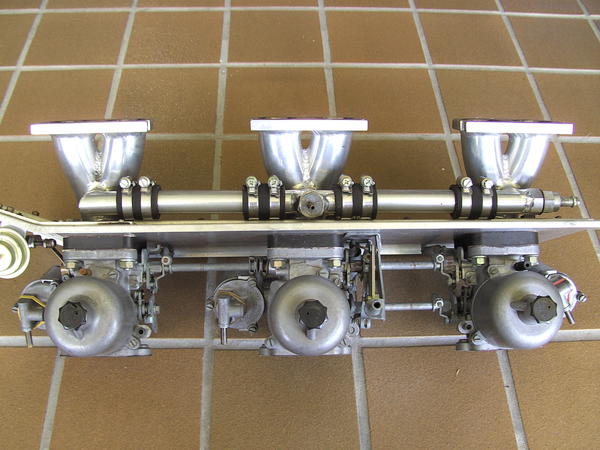
Photos attached, making the heat shield is the only difficult job.
Maniflow inlet manifolds are reported to work well, I recommend using the headers and twin exhaust system as well for economy and performance.
The difference in driving has to be experienced to believe, it becomes a 3 litre sports car, not the dull dead truck engine the factory delivered.
bruce.
The triple 1.75" SU's are the proven way to go for a road car. The factory setup does not work except for the fuel suppliers that is. Your memory of economy was spot on.
My car (from the factory) got around 17 mpg in traffic and up to 24 overall if used gently on highways.
There are hundreds of myths about how hard it is to tune 3 SU's all wrong. Once set up correctly with the throttle shafts locked up and mixtures set there is nothing to change, the trouble with multiple carbies is that people who do not understand how simple they really are keep fiddling with them and never get them right. I did this with my MGTF in early years.
The Big Healeys went from 2 to 3, for one series, then back to 2 due I believe to dealer warranty claims because the dealers mechanics kept getting them wrong, tuning 1 was about their limit.
If the jets are correctly centered (ST Needles) and the air flow into each SU is similar then it is simply a matter of mixture adjustment. I just use a piece of plastic tubing and the calibrated ear to set the throttle shafts before locking them up.
I take off the SU's complete with heat shield as a unit and replace them as a unit. I have not tuned them since 1986 except for winter to summer mixture adjustment half to one flat of the nut only. The only modification I have made is to fit a vacuum motor to adjust # 1 throttle shaft when the AC compressor cuts in/out.
Photos attached, making the heat shield is the only difficult job.
Maniflow inlet manifolds are reported to work well, I recommend using the headers and twin exhaust system as well for economy and performance.
The difference in driving has to be experienced to believe, it becomes a 3 litre sports car, not the dull dead truck engine the factory delivered.
bruce.
Attachments:
Truck photos 19 FEB 14. 005.jpg 47.4 KB

tahoe36c
Paul Hruza
|
Sep 8, 2014 08:54 PM
Joined 12 years ago
14,284 Posts
|

Bruce,
Did you ceramic coat your exhaust manifold along with the use of the heat shield by chance? I'm pretty sure this helps insulate the heat of the exhaust gases and keep everything under the bonnet cooler...
The previous owner of my CGT installed Triumph GT6 headers (2 each) and ran true dual exhausts all the way back... My plans are to ceramic coat them the next time the engine is removed.
Paul
Those who confuse Burro and Burrow don't know their @ss from a hole in the ground...
Did you ceramic coat your exhaust manifold along with the use of the heat shield by chance? I'm pretty sure this helps insulate the heat of the exhaust gases and keep everything under the bonnet cooler...
The previous owner of my CGT installed Triumph GT6 headers (2 each) and ran true dual exhausts all the way back... My plans are to ceramic coat them the next time the engine is removed.
Paul
Those who confuse Burro and Burrow don't know their @ss from a hole in the ground...
|
Sep 8, 2014 11:25 PM
Top Contributor
Joined 13 years ago
3,595 Posts
|
|
Hi Paul,
The twin layer heat shield was developed shortly after I installed the Downton Kit 45 which did not even come with the black insulating blocks. Everything was made as cheap as possible [Very British] to try to make the Kits affordable. Stage 3 was a significant percentage of the UK list price. While it may have worked in cold wet England it was hopeless in out Sub Tropical climate. All the throttle and choke shafts, the throttle mechanism etc. were just mild steel. I had to get everything zinc plated with our high humidity climate.
It was impossible to maintain a stable idle speed, the engine would stall in traffic at lights, even with the idle speed set at 1,000 rpm when cold.
I added the ceramic sheeting between the aliminium plates at the same time as I had the headers ceramic coated [inside & out] and the outside of the inlet manifolds.
This really made a big difference to the engine bay heat and allowed a steady constant idle speed within the normal limits for these old 1930's engine designs.
Now with the distributor correctly mapped my idle speed is within 50 rpm of 850 rpm which I have set with my Air-Con system. Variation with compressor clutch on or off is 50 rpm. Engine wise it is similar to a modern engine in normal traffic, the BMW varies about the same amount.
Pleased to help at any time.
Bruce.
The twin layer heat shield was developed shortly after I installed the Downton Kit 45 which did not even come with the black insulating blocks. Everything was made as cheap as possible [Very British] to try to make the Kits affordable. Stage 3 was a significant percentage of the UK list price. While it may have worked in cold wet England it was hopeless in out Sub Tropical climate. All the throttle and choke shafts, the throttle mechanism etc. were just mild steel. I had to get everything zinc plated with our high humidity climate.
It was impossible to maintain a stable idle speed, the engine would stall in traffic at lights, even with the idle speed set at 1,000 rpm when cold.
I added the ceramic sheeting between the aliminium plates at the same time as I had the headers ceramic coated [inside & out] and the outside of the inlet manifolds.
This really made a big difference to the engine bay heat and allowed a steady constant idle speed within the normal limits for these old 1930's engine designs.
Now with the distributor correctly mapped my idle speed is within 50 rpm of 850 rpm which I have set with my Air-Con system. Variation with compressor clutch on or off is 50 rpm. Engine wise it is similar to a modern engine in normal traffic, the BMW varies about the same amount.
Pleased to help at any time.
Bruce.
|
Sep 9, 2014 12:04 AM
Top Contributor
Joined 13 years ago
3,595 Posts
|
|
Paul,
Here are 6 more photos of the heat shield set up.
Bruce.
Here are 6 more photos of the heat shield set up.
Bruce.
Attachments:
Truck photos 28 MAR 14. SU heatshield 002.jpg 31.1 KB

|
Al ain, Abu Dhabi, United Arab Emirates
 Sign in to contact
|
Sep 12, 2014 07:45 AM
Joined 14 years ago
362 Posts
|
In reply to # 2792257 by PFT-000
Now with the distributor correctly mapped my idle speed is within 50 rpm of 850 rpm which I have set with my Air-Con system.
I sometimes wonder how many "carb" problems are actually down to ignition problems? The old adage of tuning TTC: Tappets, Timing (well, all the ignition) Carbs in that order is often forgotten. There is little chance of ever getting smoothing running with poor ignition performance - a problem well known amongst the unfortunate owners of the "modern" Jaguar S-type and its dodgy coil-on-plug systemEdited 1 time(s). Last edit at 2014-09-12 07:46 AM by Richard Moss.
 |
Sep 12, 2014 01:03 PM
Top Contributor
 Joined 21 years ago
19,009 Posts
|

The twin 2" will work fine (you have to hog out the intake manifold) but the triples are better. BTW, the triples are not finicky - I have no idea why everyone seems to thing that you have to be tinkering all the time. I think I've cheked tune on my triples twice in over 20 years.
Bill Spohn www.rhodo.citymax.com/carstuff.html
Current: 1958 MGA Twincam (race car (170 bhp)),1962 MGA Deluxe Coupe (98 bhp)
1957 Jamaican MGA (200 bhp)1965 1971 Jensen Interceptor (350 bhp)
2009 Pontiac Solstice GXP Coupe (375 bhp)
2007 BMW Z4M coupe (340 bhp)
Recent: 1969 MGC roadster (175 bhp),Jensen CV8 (375 bhp),
1969 Lamborghini Islero S (350 bhp), 1988 Fiero GT turbo (300 bhp)
North Vancouver BC
Bill Spohn www.rhodo.citymax.com/carstuff.html
Current: 1958 MGA Twincam (race car (170 bhp)),1962 MGA Deluxe Coupe (98 bhp)
1957 Jamaican MGA (200 bhp)1965 1971 Jensen Interceptor (350 bhp)
2009 Pontiac Solstice GXP Coupe (375 bhp)
2007 BMW Z4M coupe (340 bhp)
Recent: 1969 MGC roadster (175 bhp),Jensen CV8 (375 bhp),
1969 Lamborghini Islero S (350 bhp), 1988 Fiero GT turbo (300 bhp)
North Vancouver BC
|
Sep 13, 2014 07:30 PM
Top Contributor
Joined 13 years ago
3,595 Posts
|
|
Bill is correct.
Really there is no more trouble setting up 3 SU's than 2 SU's. once set up just don't fiddle with them. Leave them alone.
NOTE: The sound of 2 SU's is similar but with 3 the middle SU makes a different "Hiss sound" to the outer ones. If [ GREAT BIG IF ] your idle speed is steady and constant i.e. you have had your distributor correctly re-mapped with NO advance below 1,000 rpm you can use a flow meter to set the carb's. These only work if you are not fighting the engine idle speed constantly changing.
Last time I did mine [1986 from memory] I still had the dud dizzy mapping so I had to resort to the plastic tube in ear trick. Unless you have a really stable idle speed the flow meter will have you really chasing your tail, very frustrating, the old idea of a piece of rubber or plastic tube works well enough.
Bruce.
Really there is no more trouble setting up 3 SU's than 2 SU's. once set up just don't fiddle with them. Leave them alone.
NOTE: The sound of 2 SU's is similar but with 3 the middle SU makes a different "Hiss sound" to the outer ones. If [ GREAT BIG IF ] your idle speed is steady and constant i.e. you have had your distributor correctly re-mapped with NO advance below 1,000 rpm you can use a flow meter to set the carb's. These only work if you are not fighting the engine idle speed constantly changing.
Last time I did mine [1986 from memory] I still had the dud dizzy mapping so I had to resort to the plastic tube in ear trick. Unless you have a really stable idle speed the flow meter will have you really chasing your tail, very frustrating, the old idea of a piece of rubber or plastic tube works well enough.
Bruce.
 |
Sep 16, 2014 12:46 PM
Joined 12 years ago
78 Posts
|

Having trouble posting or changing forum settings?
Read the Forum Help (FAQ) or click Contact Support at the bottom of the page.