MGB & GT Forum
[Solved] Irregular ignition timing
Posted by Windmill







 |
Apr 8, 2024 03:44 AM
Joined 3 years ago
19 Posts
|


Hi All
Jeroen, check if the outer section of the harmonic balancer has rotated on the inner, moving your timing mark. The inner and outer sections are separated by a thin band of rubber. This sometimes comes "unstuck" and results in the problem you are experiencing.
Jeroen, check if the outer section of the harmonic balancer has rotated on the inner, moving your timing mark. The inner and outer sections are separated by a thin band of rubber. This sometimes comes "unstuck" and results in the problem you are experiencing.

Crispin
Crispin Allen
|
Apr 8, 2024 04:15 AM
Top Contributor
 Joined 6 years ago
1,609 Posts
|

 |
Apr 8, 2024 04:57 AM
Joined 7 years ago
429 Posts
|

X2 what Geoff says in #16. Remove radiator to get at the harmonic balance bolt and remove it to check if the timing mark is in line with the keyway.
I have just stripped my engine down for rebuild, and found out why it was difficult to time some years ago when I put an electronic dissy in. I ended up timing it by ear back then, like we did in the very old days!
So , last week when I removed the balance, the rubber had perished and the outer pulley had rotated, causing the timing issues.
I have just stripped my engine down for rebuild, and found out why it was difficult to time some years ago when I put an electronic dissy in. I ended up timing it by ear back then, like we did in the very old days!
So , last week when I removed the balance, the rubber had perished and the outer pulley had rotated, causing the timing issues.
 Philly 'burbs, PA, USA
 Sign in to contact
|
Apr 8, 2024 06:12 AM
Top Contributor
Joined 16 years ago
28,128 Posts
|

Aussie77RBB thanked dickmoritz for this post
 |
Apr 8, 2024 08:18 AM
Top Contributor
Joined 5 years ago
1,442 Posts
|
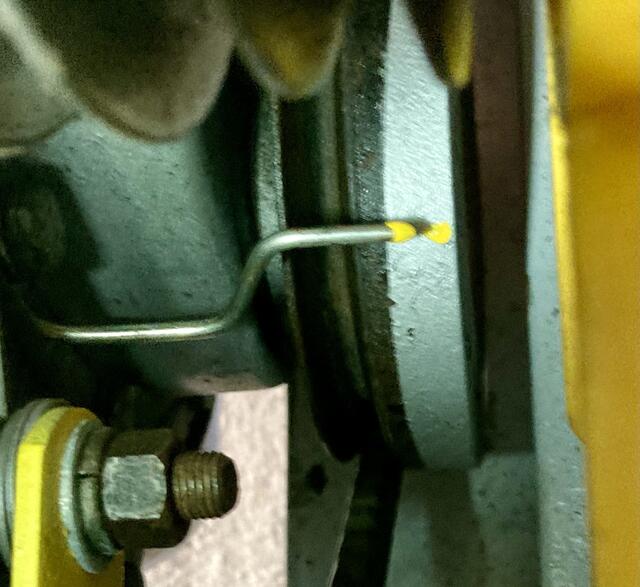
Relocating timing pointer to above eliminated much of the cursing echoing in my garage.
Used front cover bolt as attachment point.
Once TDC mark is aligned at the lower stock pointer, attach new pointer anywhere desired, and mark pulley at that new TDC indication point.
Edited 1 time(s). Last edit at 2024-04-08 08:26 AM by Drewski.
Used front cover bolt as attachment point.
Once TDC mark is aligned at the lower stock pointer, attach new pointer anywhere desired, and mark pulley at that new TDC indication point.
Edited 1 time(s). Last edit at 2024-04-08 08:26 AM by Drewski.
Attachments:
POINTER.JPG 48.3 KB
Watauga thanked Drewski for this post

Bernd Kamenicky
Bernard Kamenicky
Altlengbach, Lower Austria, Austria
 Sign in to contact
|
Apr 10, 2024 06:12 AM
Joined 10 years ago
250 Posts
|
Dear Jeroen,
I have the following Items:
1) Geoff x 3. It happened to me as well. But mind you: The perished rubber will not change ignition timing but just make it impossible to check & adjust. So the car should run fine though you have erratic timing. Your's does NOT run fine.
2) Timing chain Tensioner/Chain worn: Indeed this can be an item but on the short duplex chain of a B's OHV engine it is not as likely as on the BMW M10 OHC motor with long timing chain. Yet the noise from the motor front might be an indicator to this. And yes: The BMW M10 are prone to chain elongation with age.
3) You wrote you get around 10° per 1000rpm more advance until 3000 and end up at about 35. I hope this 35° is total and NOT advance from the 10° static. The total shall be about 34° at 3000rpm! Otherwise you have a wrong dizzy from a 70'S emission controlled car with wrong curve (details on request).
4) I still recommend you to read my first post and check AXIAL play of the dizzy drive shaft (not the one in the dizzy itself but the shaft engaging with the camshaft and driving the dizzy) and th eseat of the dizzy drive slot in this shaft. Nearly all B series engines I made in the last 30 years have too much axial play there what makes the engaging hypoid cog wheels jump axially and therewith circumferentially ending up in erratic timing. You see it on the lower (inside motor) side of the sleeve. It's usually worn. Countermeasure is rework of the sleeves flange face. Same with worn slot: Causes circumferential play.
5) Moving pointer to upper side is a good idea.
Cheers and Good Luck
Bernd
I have the following Items:
1) Geoff x 3. It happened to me as well. But mind you: The perished rubber will not change ignition timing but just make it impossible to check & adjust. So the car should run fine though you have erratic timing. Your's does NOT run fine.
2) Timing chain Tensioner/Chain worn: Indeed this can be an item but on the short duplex chain of a B's OHV engine it is not as likely as on the BMW M10 OHC motor with long timing chain. Yet the noise from the motor front might be an indicator to this. And yes: The BMW M10 are prone to chain elongation with age.
3) You wrote you get around 10° per 1000rpm more advance until 3000 and end up at about 35. I hope this 35° is total and NOT advance from the 10° static. The total shall be about 34° at 3000rpm! Otherwise you have a wrong dizzy from a 70'S emission controlled car with wrong curve (details on request).
4) I still recommend you to read my first post and check AXIAL play of the dizzy drive shaft (not the one in the dizzy itself but the shaft engaging with the camshaft and driving the dizzy) and th eseat of the dizzy drive slot in this shaft. Nearly all B series engines I made in the last 30 years have too much axial play there what makes the engaging hypoid cog wheels jump axially and therewith circumferentially ending up in erratic timing. You see it on the lower (inside motor) side of the sleeve. It's usually worn. Countermeasure is rework of the sleeves flange face. Same with worn slot: Causes circumferential play.
5) Moving pointer to upper side is a good idea.
Cheers and Good Luck
Bernd
|
|
Apr 10, 2024 07:02 AM
Top Contributor
Joined 12 years ago
1,009 Posts
|
Argh distributors.The original ignition is generally satisfactory but the law of diminishing returns and increasing frustrations can result when chasing these type of issues.
The moment my B gives any issues like that such as axial float on the drive shaft resulting in irregular timing I will be throwing the distributor straight in the trash and ordering a trigger wheel, EDIS and Megajolt.
The moment my B gives any issues like that such as axial float on the drive shaft resulting in irregular timing I will be throwing the distributor straight in the trash and ordering a trigger wheel, EDIS and Megajolt.
rocannon thanked Not-Anumber for this post
|
Bernd Kamenicky
Bernard Kamenicky
Altlengbach, Lower Austria, Austria
Sign in to contact
|
Apr 11, 2024 05:09 AM
Joined 10 years ago
250 Posts
|
Hi guys,
for clarification: the problem with axial play in the dizzy drive shaft is that it is NOT a matter of the dizzy.
In fact the distributor drive spindle (#41) works itself into the cast drive housing sleeve (#42). See yellow mark and blue arrows.
The hereby generatey axial play automatically produces circumferential backlash (hypoid gear). See red arrow.
Same does worn out slot in the distributor drive spindle (#41).
The dizzy can be perfect, worn out drive has same consequences as loose timing chain.
Cheers
Bernd
for clarification: the problem with axial play in the dizzy drive shaft is that it is NOT a matter of the dizzy.
In fact the distributor drive spindle (#41) works itself into the cast drive housing sleeve (#42). See yellow mark and blue arrows.
The hereby generatey axial play automatically produces circumferential backlash (hypoid gear). See red arrow.
Same does worn out slot in the distributor drive spindle (#41).
The dizzy can be perfect, worn out drive has same consequences as loose timing chain.
Cheers
Bernd
Attachments:
Dizzy_Drive.jpg 71.3 KB

 |
Apr 11, 2024 07:04 AM
Top Contributor
Joined 19 years ago
20,900 Posts
|
While this can impact how much total timing a car receives from the distributor due to gear climb, advance springs are almost aways responsible for wandering timing that you'll see moving with the timing light at idle.
jeff@advanceddistributors.com
jeff@advanceddistributors.com
 |
Apr 11, 2024 02:49 PM
Top Contributor
Joined 2 years ago
857 Posts
|
Just because both valves are in the closed position does not mean the piston is at TDC. You need to employ some sort of visual conformation that the piston is exactly at TDC.
In reply to # 4782369 by Windmill
Update on this issue: I made some progress but haven't solved it yet.
I took the distributor and brought it to a friend who has a distributor bench-test setup. Here we confirmed that the distributor is good and works how it is supposed to do. It generates proper sparks, its static advance is correct and the advance increases with 10 degrees per 1,000 rpm engine speed until it maxes out at approximately 32~35 degrees advance.
I installed the distributor back on the car and still had very rough idling and can't get the ignition timing right. I then did another test: took off the rocker cover and the cover from the distributor. Now I can see where the distributor arm is pointing, and can see whether the valves on cylinder #1 are pushed open. I manually rotated the engine until the rotor arm is pointing towards cylinder #1 and both valves on cylinder #1 are closed. This should be cylinder #1 top dead center (TDC). The timing mark on the pulley should now be at the bottom, at the 6 o'clock position: were it always was. But it isn't! The timing mark is now close to the 11 o'clock position.
My guess is that either the pulley has come loose from the shaft, or that the timing chain has jumped a couple of teeth. However, to verify this hypothesis I need to remove the timing cover. There is no space in front of the engine, so I think that I have to take the engine out of the car to inspect this.
I took the distributor and brought it to a friend who has a distributor bench-test setup. Here we confirmed that the distributor is good and works how it is supposed to do. It generates proper sparks, its static advance is correct and the advance increases with 10 degrees per 1,000 rpm engine speed until it maxes out at approximately 32~35 degrees advance.
I installed the distributor back on the car and still had very rough idling and can't get the ignition timing right. I then did another test: took off the rocker cover and the cover from the distributor. Now I can see where the distributor arm is pointing, and can see whether the valves on cylinder #1 are pushed open. I manually rotated the engine until the rotor arm is pointing towards cylinder #1 and both valves on cylinder #1 are closed. This should be cylinder #1 top dead center (TDC). The timing mark on the pulley should now be at the bottom, at the 6 o'clock position: were it always was. But it isn't! The timing mark is now close to the 11 o'clock position.
My guess is that either the pulley has come loose from the shaft, or that the timing chain has jumped a couple of teeth. However, to verify this hypothesis I need to remove the timing cover. There is no space in front of the engine, so I think that I have to take the engine out of the car to inspect this.
about 4 months and 3 weeks later...
|
Topic Creator (OP)
Sep 5, 2024 12:10 AM
Top Contributor
Joined 5 years ago
1,106 Posts
|
|

In case in the future somebody stumbles upon this topic, let me close it as solved. Here is a brief description of what I did:
The car got parked for about three months as other things took a higher priority. Only in July was I able to proceed further. I had to take the engine out to replace the clutch (described in a different topic: https://www.mgexp.com/forum/mgb-and-gt-forum.1/clutch-woes-might-have-to-pull-the-engine.4751711/ ). I used this opportunity to look at the ignition timing related parts. I suspected that something had gone wrong with the timing chain setup.
During removal of the fan belt I noticed that the crankshaft pulley was damaged. The rubber ring that forms the damper had disintegrated. This had not been obvious with the fan belt in place: the force from the belt held the the pulley in a stable position. I showed a short video in this topic: https://www.mgexp.com/forum/mgb-and-gt-forum.1/crankshaft-pulley-repair-or-replace.4819255.4819325/ However, this can not have been the cause for irregular ignition timing as this pulley is not slipping back and forth. I decided to buy a replacement at British Parts Northwest, the product page is here: https://bpnorthwest.com/mg/crankshaft-pulley-and-damper-mgb-63-to-74/
To my surprise were the timing chain and sprockets in good condition. Only the tensioner did not work well, leaving some slack in the chain. The sprockets had not "jumped a tooth": the dimples lined up nicely when piston #1 is at TDC. I decided to replace the tensioner (Rimmer Bros part number 12H3292, plus locktab AEC340), and also to install a new oil seal (88G561) in the timing chain cover. I needed a new gasket (12H1319) for this cover.
I also used this opportunity to install Joe Baba's TDC pointer (see for details: https://www.mgexp.com/forum/vendor-market.68/tdc-pointer-update.4805771/ ). This has two benefits for me. The original timing marks are at the bottom of the pulley. So I would have to lay down in front of the car to get a reading, then stand up to modify the distributor setting, then repeat. With this new pointer it is not necessary to lay down each time to take a measurement. The second reason is that the original markings got damaged and hardly stuck out beyond the pulley, so even more difficult to read. I'm very happy with this upgrade.
An additional thing I did was to inspect the distributor drive spindle. This one is in a good condition, no damage or wear to the gears observed. (Tip: use the long bolt from the air filter to get this spindle out of the engine).
After I had installed the engine I could not start the car. I found that the spark plug wires had gone bad. Usually such wires have a resistance of several thousand Ohms (approx. 3~5 kOhms). These wires had at least a hundred times higher resistance. This was the first time for me to measure those cables, so I don't have any indication whether they recently got bad, or that they have always been bad. I installed some locally sourced cables. And gave the car four new spark plugs as the previous ones were rather black.
Having done all this now the car starts and runs, and the timing is stable, no longer irregular. But because I replaced multiple parts during this process I can not really pinpoint which part was responsible for making the ignition timing irregular, as the title of the topic indicates.
The car got parked for about three months as other things took a higher priority. Only in July was I able to proceed further. I had to take the engine out to replace the clutch (described in a different topic: https://www.mgexp.com/forum/mgb-and-gt-forum.1/clutch-woes-might-have-to-pull-the-engine.4751711/ ). I used this opportunity to look at the ignition timing related parts. I suspected that something had gone wrong with the timing chain setup.
During removal of the fan belt I noticed that the crankshaft pulley was damaged. The rubber ring that forms the damper had disintegrated. This had not been obvious with the fan belt in place: the force from the belt held the the pulley in a stable position. I showed a short video in this topic: https://www.mgexp.com/forum/mgb-and-gt-forum.1/crankshaft-pulley-repair-or-replace.4819255.4819325/ However, this can not have been the cause for irregular ignition timing as this pulley is not slipping back and forth. I decided to buy a replacement at British Parts Northwest, the product page is here: https://bpnorthwest.com/mg/crankshaft-pulley-and-damper-mgb-63-to-74/
To my surprise were the timing chain and sprockets in good condition. Only the tensioner did not work well, leaving some slack in the chain. The sprockets had not "jumped a tooth": the dimples lined up nicely when piston #1 is at TDC. I decided to replace the tensioner (Rimmer Bros part number 12H3292, plus locktab AEC340), and also to install a new oil seal (88G561) in the timing chain cover. I needed a new gasket (12H1319) for this cover.
I also used this opportunity to install Joe Baba's TDC pointer (see for details: https://www.mgexp.com/forum/vendor-market.68/tdc-pointer-update.4805771/ ). This has two benefits for me. The original timing marks are at the bottom of the pulley. So I would have to lay down in front of the car to get a reading, then stand up to modify the distributor setting, then repeat. With this new pointer it is not necessary to lay down each time to take a measurement. The second reason is that the original markings got damaged and hardly stuck out beyond the pulley, so even more difficult to read. I'm very happy with this upgrade.
An additional thing I did was to inspect the distributor drive spindle. This one is in a good condition, no damage or wear to the gears observed. (Tip: use the long bolt from the air filter to get this spindle out of the engine).
After I had installed the engine I could not start the car. I found that the spark plug wires had gone bad. Usually such wires have a resistance of several thousand Ohms (approx. 3~5 kOhms). These wires had at least a hundred times higher resistance. This was the first time for me to measure those cables, so I don't have any indication whether they recently got bad, or that they have always been bad. I installed some locally sourced cables. And gave the car four new spark plugs as the previous ones were rather black.
Having done all this now the car starts and runs, and the timing is stable, no longer irregular. But because I replaced multiple parts during this process I can not really pinpoint which part was responsible for making the ignition timing irregular, as the title of the topic indicates.
rocannon thanked Windmill for this post

L.Clay.Collins
Clay Collins
|
Sep 5, 2024 10:55 AM
Joined 7 years ago
170 Posts
|
Thanks so much for the detailed follow up. It sounds like the only item addressed related to timing fluctuations would be the loose timing chain tensioner. Others mentioned there just isn’t all that much slack on our short MG chains like on my old OHC BMW 2002. I wonder if intermittent firing through the #1 spark plug wire could affect your timing light strobe flashing and make it look like the timing was varying.
Having trouble posting or changing forum settings?
Read the Forum Help (FAQ) or click Contact Support at the bottom of the page.