MGB & GT Forum
Cherry Bomb type mufflers ?
Posted by notyet-MG







 |
Topic Creator (OP)
Dec 5, 2013 02:20 PM
Joined 18 years ago
580 Posts
|
What's your experience/thoughts on a Cherry Bomb type muffler ? I'm building an exhaust system and was thinking about the straight through type muffler. However, withouht back pressure how does that effect performance? Or am I misunderstanding how the things work? There was a member here who used a mufler from a Harley.
 |
Dec 5, 2013 02:24 PM
Joined 14 years ago
2,558 Posts
|
|
urbex
Eric K
|
Dec 5, 2013 02:38 PM
Joined 12 years ago
101 Posts
|
In reply to # 2540941 by notyet-MG
However, withouht back pressure how does that effect performance? Or am I misunderstanding how the things work?
Yes. Backpressure is a myth. What you want to maintain for torque is the velocity. Losing velocity is what can affect low RPM torque. Backpressure is bad, period.
This comes about when people chop the exhaust at the collector off at the manifold or header, and the car falls on it's face, figurately speaking, performance wise. This will also happen when someone goes to an exhaust tubing size that's too large for the engine, or header primaries that are too large. Then the "logic" kicks in, and it's assumed that backpressure is needed.
If it were really that simple, all one would need to do is go to a smaller tubing, or partially restrict the exhaust, and torque would go up. Obviously it doesn't work this way.
The key is to minimize or eliminate any restriction in the exhaust, while at the same maintaining the velocity, or in other words - the flow of the exhaust gases. A good explanation can be found here - http://www.gomog.com/allmorgan/exhaustbackpressure.html
|
Dec 5, 2013 03:00 PM
Joined 17 years ago
999 Posts
|
|
That was a good article on back pressure. 25 years ago I built a hot rod, and everybody said use a 2.5 inch exhaust. It was loud, and performance was ok. A year or 2 later I replaced the system with 2 inch pipe and gained a lot of low to mid range torque, and better fuel economy. I bought a flathead powered bucket T hot rod a few years ago and it had dual 2.5 inch pipes and cherry bomb mufflers, and ran poorly. The little flathead only displaced 239 cubic inches. I installed dual 1.75 inch pipes and some straight through mufflers and it ran and sounded much better. No huge pipes for me.

|
Raleigh72MGB
Michael Byrne
|
Dec 5, 2013 03:06 PM
Joined 13 years ago
918 Posts
|
 |
Dec 5, 2013 03:16 PM
Top Contributor
 Joined 14 years ago
19,562 Posts
|

Back pressure is an essential ingredient for a 2 stroke engines not a 4.
Even with a cherry bomb my DoubleS system was way too loud when I gave it full benefit and siamesing the twin pipes at the back quietened it down to an acceptable level.
Although it might look a bit scabby it is SS and is 27 years old !

Even with a cherry bomb my DoubleS system was way too loud when I gave it full benefit and siamesing the twin pipes at the back quietened it down to an acceptable level.
Although it might look a bit scabby it is SS and is 27 years old !
Attachments:
IMG_3795.JPG 39.4 KB

 |
Dec 5, 2013 03:23 PM
Joined 12 years ago
1,216 Posts
|
|
urbex
Eric K
|
Dec 5, 2013 03:23 PM
Joined 12 years ago
101 Posts
|
In reply to # 2541001 by ErnieY
Back pressure is an essential ingredient for a 2 stroke engines not a 4.
Not true. It's even worse on a 2 stroke than on a 4 stroke. However, a properly designed 2 stroke exhaust will produce pressure waves, both negative (vacuum), and positive (pressure), that will help to scavenge exhaust out of the cylinder, as well as present a "blocking" of sorts to prevent the incoming charge from blowing right through the cylinder and down the exhaust. This is why many 2 strokes will run like pure crap if you attempt to just bolt on a "straight pipe" like what could be done to a 4 stroke.
|
|
Dec 5, 2013 03:31 PM
Top Contributor
Joined 14 years ago
19,562 Posts
|

 |
Dec 5, 2013 03:39 PM
Joined 20 years ago
8,982 Posts
|
Cherry Bomb also makes "turbo" mufflers which are quieter than the glass pack style. I got mine from Summit Racing for $20 on e-bay with free shipping I think. Sounds good in the driveway, but I haven't gotten it all together for a drive yet…so we'll see.
1974-1/2 Roadster, "Bumble Bee", Corvette Yellow - in shambles, wire wheels
1976 Roadster, "Virus", Sandglow - "driver" condition (stock + 32/36 Weber DGEV, cast iron header, 25D distributor), bolt on wheels, ON the road!
1974-1/2 Roadster, "Bumble Bee", Corvette Yellow - in shambles, wire wheels
1976 Roadster, "Virus", Sandglow - "driver" condition (stock + 32/36 Weber DGEV, cast iron header, 25D distributor), bolt on wheels, ON the road!
 |
Dec 5, 2013 04:02 PM
Joined 12 years ago
729 Posts
|

Bankerdanny
Daniel Palmer
|
Dec 5, 2013 04:29 PM
Top Contributor
Joined 14 years ago
2,304 Posts
|
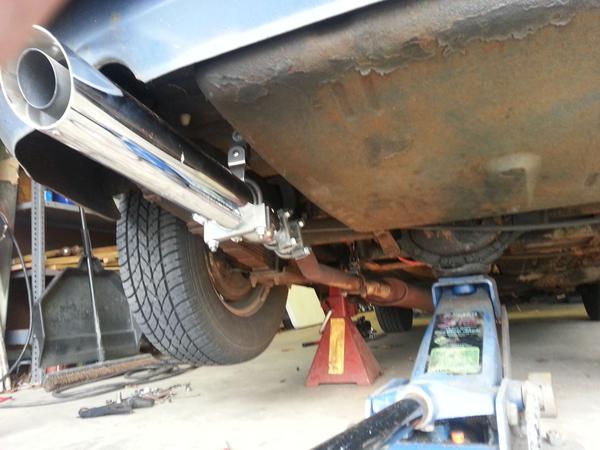
I just installed a Harley takeoff on the rear of my '72. I still have the stock center muffler.
For a while I ran without a center muffler and only the stock rear, it was loud, but not excessively so.
Endeavor to Persevere
"The problem with quotes on the Internet is that you never know if they're true" - Abraham Lincoln
For a while I ran without a center muffler and only the stock rear, it was loud, but not excessively so.
Endeavor to Persevere
"The problem with quotes on the Internet is that you never know if they're true" - Abraham Lincoln
Attachments:
20131201_131713.jpg 40.3 KB

ohlord
Rob C
A tiny Island off the coast of Washington State, N.W., USA
 Sign in to contact
1957 Land Rover Series I "EYEYIYI"
1957 Land Rover Series I "OVRLND" 1971 MG MGB 1971 MG MGB "Bedouin 2" & more |
Dec 5, 2013 04:35 PM
Top Contributor
 Joined 14 years ago
28,879 Posts
|
In reply to # 2540962 by urbex
Yes. Backpressure is a myth. What you want to maintain for torque is the velocity. Losing velocity is what can affect low RPM torque. Backpressure is bad, period.
This comes about when people chop the exhaust at the collector off at the manifold or header, and the car falls on it's face, figurately speaking, performance wise. This will also happen when someone goes to an exhaust tubing size that's too large for the engine, or header primaries that are too large. Then the "logic" kicks in, and it's assumed that backpressure is needed.
If it were really that simple, all one would need to do is go to a smaller tubing, or partially restrict the exhaust, and torque would go up. Obviously it doesn't work this way.
The key is to minimize or eliminate any restriction in the exhaust, while at the same maintaining the velocity, or in other words - the flow of the exhaust gases. A good explanation can be found here - http://www.gomog.com/allmorgan/exhaustbackpressure.html
Torque does increase at lower rpms where it is needed most on the street. Your thinking is flawed. A perfect system would have torque moving up the band as an exhaust lost some but not all back pressure as the car accelerated.
In reply to # 2540941 by notyet-MG
However, withouht back pressure how does that effect performance? Or am I misunderstanding how the things work?
Yes. Backpressure is a myth. What you want to maintain for torque is the velocity. Losing velocity is what can affect low RPM torque. Backpressure is bad, period.
This comes about when people chop the exhaust at the collector off at the manifold or header, and the car falls on it's face, figurately speaking, performance wise. This will also happen when someone goes to an exhaust tubing size that's too large for the engine, or header primaries that are too large. Then the "logic" kicks in, and it's assumed that backpressure is needed.
If it were really that simple, all one would need to do is go to a smaller tubing, or partially restrict the exhaust, and torque would go up. Obviously it doesn't work this way.
The key is to minimize or eliminate any restriction in the exhaust, while at the same maintaining the velocity, or in other words - the flow of the exhaust gases. A good explanation can be found here - http://www.gomog.com/allmorgan/exhaustbackpressure.html
If you have no back pressure you have incomplete cylinder charging and that is an engine that falls on its face.
A Chevy Small Block has more torque at 3000rpm running 1 3/4 inch pipes than the same engine running 3 in tubes at the same rpm.
Been there,done it. Back pressure is a necessity in an internal combustion engine,arriving at the ideal is an art and mixture of science.
Not Bad. Period.
No matter what you think or have regurgitated from someplace on the interweb

If back pressure didn't matter all exhaust valves would be as big as possible and the cam exhaust lobe would shove it open as far as possible during the exhaust stroke. You build an engine that does that and tell he how much torque it has when you move away from a stop light.
As an addendum go out to the garage and remove your MGB muffler both if you run them and take it for a ride. Tell us all what happens when you pull away at an idle and what happens to your fuel mileage as you go blasting around town at ear shattering noise levels.
Please
LNDRVR4X4.COM
Home of Project "INCARN8'
1957 Series 1 Land Rover electric VEHICLE CONVERSION
FIXITUPCHAP.COM
FIXITUPCHAP INCORPORATED
RD3 Radar/ Electronic Warfare Technician
VIETNAM 1969-1972
Edited 1 time(s). Last edit at 2013-12-05 04:44 PM by ohlord.
|
urbex
Eric K
|
Dec 5, 2013 05:05 PM
Joined 12 years ago
101 Posts
|
In reply to # 2541070 by ohlord
Torque does increase at lower rpms where it is needed most on the street. Your thinking is flawed. A perfect system would have torque moving up the band as an exhaust lost some but not all back pressure as the car accelerated.
If you have no back pressure you have incomplete cylinder charging and that is an engine that falls on its face.
A Chevy Small Block has more torque at 3000rpm running 1 3/4 inch pipes than the same engine running 3 in tubes at the same rpm.
Been there,done it. Back pressure is a necessity in an internal combustion engine,arriving at the ideal is an art and mixture of science.
Not Bad. Period.
No matter what you think or have regurgitated from someplace on the interweb
If back pressure didn't matter all exhaust valves would be as big as possible and the cam exhaust lobe would shove it open as far as possible during the exhaust stroke. You build an engine that does that and tell he how much torque it has when you move away from a stop light.
As an addendum go out to the garage and remove your MGB muffler both if you run them and take it for a ride. Tell us all what happens when you pull away at an idle and what happens to your fuel mileage as you go blasting around town at ear shattering noise levels.
Please
Torque does increase at lower rpms where it is needed most on the street. Your thinking is flawed. A perfect system would have torque moving up the band as an exhaust lost some but not all back pressure as the car accelerated.
If you have no back pressure you have incomplete cylinder charging and that is an engine that falls on its face.
A Chevy Small Block has more torque at 3000rpm running 1 3/4 inch pipes than the same engine running 3 in tubes at the same rpm.
Been there,done it. Back pressure is a necessity in an internal combustion engine,arriving at the ideal is an art and mixture of science.
Not Bad. Period.
No matter what you think or have regurgitated from someplace on the interweb
If back pressure didn't matter all exhaust valves would be as big as possible and the cam exhaust lobe would shove it open as far as possible during the exhaust stroke. You build an engine that does that and tell he how much torque it has when you move away from a stop light.
As an addendum go out to the garage and remove your MGB muffler both if you run them and take it for a ride. Tell us all what happens when you pull away at an idle and what happens to your fuel mileage as you go blasting around town at ear shattering noise levels.
Please
I don't need to upset the neighbors in order to prove a point, lol.
Opening the exhaust valves to monstrous proportions and going to a long duration cam is going to kill the velocity, and THAT'S what's killing the low RPM power. By going to a huge opening and tube, the exhaust will basically stall in the manifolds, causing a back pressure block, preventing full evacuation of the exhaust gases and by extension, preventing a full charge of incoming fuel and air. You want velocity - the speed at which the exhaust gases are moving through the exhaust system to remain high, which means you want neither tubing that's too small, or too big. Of course, like everything else, compromises will need to be made. Either set up the system for maximum low RPM power with smaller tubes, high RPM power with larger tubes, or somewhere in between.
There's no art in it at all - it's strictly science (largely physics, and more strictly - fluid dynamics), and what compromises need to be made in order to reach the intended goal.
Intentionally creating back pressure is the principle that an exhaust brake works on.
It's OK if you don't believe me, we're all free to have our own opinions
 . Or, Google "back pressure myth". Or go talk to a mechanical engineer experienced in fluid dynamics.
 |
Dec 5, 2013 05:15 PM
Joined 19 years ago
1,233 Posts
|
I had one red cherry bomb on the rear of the car. Loud! On deceleration or downshift, it woud gurgle, burp and pop quite a bit. I installed another cherry bomb in the middle of the system . Still loud but not quite as loud. The gb&p is still there but not as obnoxious. Currently, I have a stock muffler in the middle with a cherry bomb at the rear with a Monza tip welded on. Loud but livable! Very little gb&p now.
Having trouble posting or changing forum settings?
Read the Forum Help (FAQ) or click Contact Support at the bottom of the page.