MG Engine Swaps Forum
LS4 swap
Posted by Jim Blackwood







|
Re: LS4 swap
#76
|
|
 |
Jan 9, 2017 03:24 PM
Joined 21 years ago
904 Posts
|
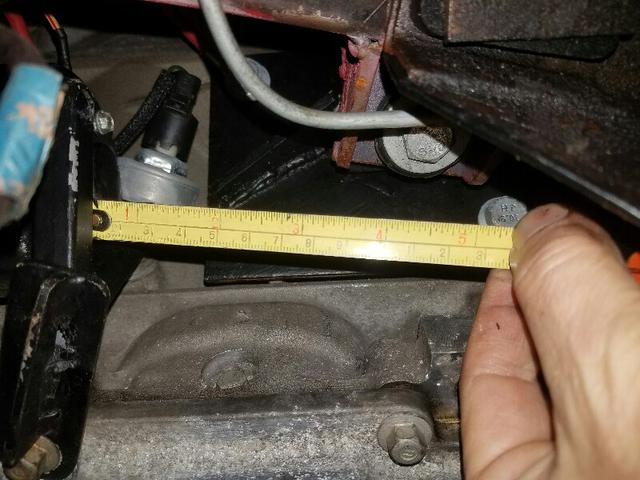
You're looking at 1 5/8" pipe in the pic. Not a lot of room around the frame rails especially on the passenger side. I went into this in my build thread but I'm estimating that I could have snaked a 2" pipe between the starter and the motor mount but probably nothing bigger. On the driver's side you'd have to go around the steering shaft, probably with some oval pipe. That approach would have been much, much more work for an end result that was no better than what you see, I thought. Believe me, I HATED having to cut into the fender well.
I have a tentative idea in my mind for some long tube headers that I would never consider until after I retire, if ever. I would go up out of the exhaust ports and route (snake is a better word) the pipes toward the very back inside corner of the wheel well. I'd bundle the pipes together through the fender well and then into a properly designed collector. The pipe off the collector would bend 90 degrees toward the back of the car. It would look like spaghetti up on top but I was figuring it might be possible to get equal length 30" primaries (give or take) that way after some quick measurements. I'd use 1 5/8" pipe. This would be a ton of work and take me many months to complete. There are still many unanswered questions as well but it's fun to daydream about this stuff sometimes.
I have a tentative idea in my mind for some long tube headers that I would never consider until after I retire, if ever. I would go up out of the exhaust ports and route (snake is a better word) the pipes toward the very back inside corner of the wheel well. I'd bundle the pipes together through the fender well and then into a properly designed collector. The pipe off the collector would bend 90 degrees toward the back of the car. It would look like spaghetti up on top but I was figuring it might be possible to get equal length 30" primaries (give or take) that way after some quick measurements. I'd use 1 5/8" pipe. This would be a ton of work and take me many months to complete. There are still many unanswered questions as well but it's fun to daydream about this stuff sometimes.
|
Re: LS4 swap
#77
|
|
 |
Jan 9, 2017 03:25 PM
Joined 15 years ago
174 Posts
|

|
Re: LS4 swap
#78
|
|
|
|
Jan 10, 2017 07:15 AM
Joined 21 years ago
904 Posts
|
In reply to # 3426953 by V8MGBV8
Even if we manage to squeeze this engine in without surgery, there is still going to be the issue of exhaust routing. Not everyone can build their own headers. So, I have been pondering the possibility of making use of what is available. That could mean doing minor surgery on an off-the-shelf header, or maybe a cast iron exhaust?
Just happened to remember that, I believe, Pete said he had prototype headers for an LS. Have you checked with him?
|
Re: LS4 swap
#79
|
|
 |
Jan 10, 2017 09:37 AM
Top Contributor
 Joined 21 years ago
17,758 Posts
|
No I haven't, Scott. Of course, any ready made header would be dependent upon engine location.
Thanks for that fenderwell/header pic, BTW! Really show what little space there is for an exhaust manifold/header. You did a great job fabbing yours.
Nothing wrong with 1 5/8" header primaries. In fact, they are the correct choice for most small block V8 engines. They will support well in excess of 400hp. Some say up to 500hp. You might lose a few ponies way upstairs, but you gain real world torque. The 1 3/4" headers are for big horsepower & big RPM applications. My '68 Camaro was calculated to be putting 400hp to the wheels using a Quarter Jr. program, along with 1/4 mile times & top speeds, weather, altitude, car weight, tire sizes, engine specifics, etc. It's pretty darn close. Yep, done with 1/58" headers while winding the engine to 7 grand.
Thanks for that fenderwell/header pic, BTW! Really show what little space there is for an exhaust manifold/header. You did a great job fabbing yours.
Nothing wrong with 1 5/8" header primaries. In fact, they are the correct choice for most small block V8 engines. They will support well in excess of 400hp. Some say up to 500hp. You might lose a few ponies way upstairs, but you gain real world torque. The 1 3/4" headers are for big horsepower & big RPM applications. My '68 Camaro was calculated to be putting 400hp to the wheels using a Quarter Jr. program, along with 1/4 mile times & top speeds, weather, altitude, car weight, tire sizes, engine specifics, etc. It's pretty darn close. Yep, done with 1/58" headers while winding the engine to 7 grand.
|
Re: LS4 swap
#80
|
|

Jim Blackwood
* BlownMGB-V8
Gunpowder Rd, Florence, KY, USA
 Sign in to contact
|
Topic Creator (OP)
Jan 10, 2017 11:30 AM
Top Contributor
Joined 19 years ago
9,572 Posts
|
Barry, you are quite correct but C's are considerably less common.
Those were some good shots you came up with too Carl.
Headers are going to be tricky, that's indisputable.
If I remember correctly, I believe I had 80 hours in on my set of fenderwell headers for the 215. That was back in the early 80's and I work slower these days. I was able to dedicate whole days to it then too. Having done that, I believe I could do a better job of it, and in fewer hours, but it'll still be very tight. Those were also 1-5/8" tubes. If Pete has headers that will work that is obviously going to be the easy solution but I agree, engine position matters.
I want to try to get at least 24" of primary tube in there. I don't know what that will take for a RV8 or block style header, stuffing 4ea 1-5/8" tubes down past the rails will not be fun, but with front mounts on the block there may be room. If we can do it once we can jig it up to do it again. I'm not above dimpling the tubes to make it happen.
Also I'm not quite so dead set on equal length tubes as I once was. I still believe it affects intake tuning and mixture distribution but with port injectors that seems to be less critical and modern EFI controllers can vary the mixture by cylinder making it even less of a concern. For a max effort I would still insist on it but these cars aren't that. This swap will have horsepower to spare. Still, I would rather not hobble it with a sub-par exhaust as most of our cars are, if it can be avoided.
Jim
Those were some good shots you came up with too Carl.
Headers are going to be tricky, that's indisputable.
If I remember correctly, I believe I had 80 hours in on my set of fenderwell headers for the 215. That was back in the early 80's and I work slower these days. I was able to dedicate whole days to it then too. Having done that, I believe I could do a better job of it, and in fewer hours, but it'll still be very tight. Those were also 1-5/8" tubes. If Pete has headers that will work that is obviously going to be the easy solution but I agree, engine position matters.
I want to try to get at least 24" of primary tube in there. I don't know what that will take for a RV8 or block style header, stuffing 4ea 1-5/8" tubes down past the rails will not be fun, but with front mounts on the block there may be room. If we can do it once we can jig it up to do it again. I'm not above dimpling the tubes to make it happen.
Also I'm not quite so dead set on equal length tubes as I once was. I still believe it affects intake tuning and mixture distribution but with port injectors that seems to be less critical and modern EFI controllers can vary the mixture by cylinder making it even less of a concern. For a max effort I would still insist on it but these cars aren't that. This swap will have horsepower to spare. Still, I would rather not hobble it with a sub-par exhaust as most of our cars are, if it can be avoided.
Jim
|
Re: LS4 swap
#81
|
|
|
|
Jan 10, 2017 04:51 PM
Joined 21 years ago
904 Posts
|
While we are on the subject of exhaust, I came across this thread about the LT4 a few months back. I was intrigued by the exhaust on this engine and the way they paired the tubes. They support 650 HP. This would be pretty easy to adapt to an LS in a B.
|
Re: LS4 swap
#82
|
|
|
|
Jan 11, 2017 10:16 AM
Top Contributor
Joined 21 years ago
17,758 Posts
|
For those that haven't heard of them, Liquid Iron Industries is a source for DIY pieces parts.
https://liquidironindustries.com/GM-LS-Motor-Mounts.html
https://liquidironindustries.com/GM-LS-Motor-Mounts.html
|
Re: LS4 swap
#83
|
|
|
Jim Blackwood
* BlownMGB-V8
Gunpowder Rd, Florence, KY, USA
Sign in to contact
|
Topic Creator (OP)
Jan 11, 2017 11:32 AM
Top Contributor
Joined 19 years ago
9,572 Posts
|
That is a Tri-Y arrangement, not terribly different from the headers i made for my Jetfire turbo, except it went up over the engine and merged at a 4-1 collector at the turbo inlet. The ports are paired that way due to the cylinder sequencing. On a full Tri-Y header you would want to pair them the same way to optimize scavenging.
Tri-Y headers could be an option here but the congested area is close to the block so it doesn't really help much.
The most promising arrangement to fit through the available space might be 4 tubes inline. This has the disadvantage of inherently making the 3rd tube back the shortest and the front one the longest. However, by using a longer collector the short tube can be extended inside the collector which has minimal effect on collector operation.
So a call for opinion is in order I think, particularly from those of you who have block hugger type exhausts. From the headers back, which would be better, or would it make any difference?
Jim
Tri-Y headers could be an option here but the congested area is close to the block so it doesn't really help much.
The most promising arrangement to fit through the available space might be 4 tubes inline. This has the disadvantage of inherently making the 3rd tube back the shortest and the front one the longest. However, by using a longer collector the short tube can be extended inside the collector which has minimal effect on collector operation.
So a call for opinion is in order I think, particularly from those of you who have block hugger type exhausts. From the headers back, which would be better, or would it make any difference?
Jim
|
Re: LS4 swap
#84
|
|
|
|
Jan 11, 2017 06:16 PM
Joined 21 years ago
904 Posts
|
Ok, I guess I wasn't very clear on my LT4 header comments.....might have something to do with getting up at 3 AM after only getting one hour of sleep.  I wasn't suggesting using those headers but doing a custom set of through the fender units that maintain the tube pairings and lengths. I know this isn't what you want to do Jim. I was just offering other options. I'd be apt to go this route rather than long tube headers in the unlikely event I ever make a change. I think it would be easy to do.
So I hope I'm not sounding like a naysayer, that is not at all what I'm trying to do. I just happen to have the motor we are discussing sitting in the car we are discussing. When someone says I'm going to do this or that I can walk out into the garage and look, mostly to satisfy my own curiosity. This is my hobby so I'm very interested in the subject. If I'm understanding what you are proposing Jim.......block hugger headers using 1 5/8" pipe with the 4 pipes side by side as they go past the block and "frame rails" then I can tell you what I am seeing. On my car on the passenger's side you have from the starter to the motor mount as the only spot to use. I think I measured at most 3 inches between the two and maybe 2.5"-3" wide. You're talking about using motor mounts off the front of the heads so there won't be any mounts to worry about in that area for you. The "frame rails" start to narrow down for the suspension in this area though and you are talking about moving the motor forward from 1 to 3 inches from where I have mine. The block has less than an inch clearance where the frame narrows. You aren't really gaining anything with your motor mount approach and actually you will probably have less room than I do. If I figured things correctly 4 pipes side by side is 6.5" by 1 5/8" so realistically you'll need a slot that is close to 7" x 2". I'm having a hard time seeing how that works here. I can try to get a picture of this area over the weekend if it will be helpful? This motor fills the engine bay up for sure. I am anxious to see how you solve this.
I wasn't suggesting using those headers but doing a custom set of through the fender units that maintain the tube pairings and lengths. I know this isn't what you want to do Jim. I was just offering other options. I'd be apt to go this route rather than long tube headers in the unlikely event I ever make a change. I think it would be easy to do.
So I hope I'm not sounding like a naysayer, that is not at all what I'm trying to do. I just happen to have the motor we are discussing sitting in the car we are discussing. When someone says I'm going to do this or that I can walk out into the garage and look, mostly to satisfy my own curiosity. This is my hobby so I'm very interested in the subject. If I'm understanding what you are proposing Jim.......block hugger headers using 1 5/8" pipe with the 4 pipes side by side as they go past the block and "frame rails" then I can tell you what I am seeing. On my car on the passenger's side you have from the starter to the motor mount as the only spot to use. I think I measured at most 3 inches between the two and maybe 2.5"-3" wide. You're talking about using motor mounts off the front of the heads so there won't be any mounts to worry about in that area for you. The "frame rails" start to narrow down for the suspension in this area though and you are talking about moving the motor forward from 1 to 3 inches from where I have mine. The block has less than an inch clearance where the frame narrows. You aren't really gaining anything with your motor mount approach and actually you will probably have less room than I do. If I figured things correctly 4 pipes side by side is 6.5" by 1 5/8" so realistically you'll need a slot that is close to 7" x 2". I'm having a hard time seeing how that works here. I can try to get a picture of this area over the weekend if it will be helpful? This motor fills the engine bay up for sure. I am anxious to see how you solve this.
|
Re: LS4 swap
#85
|
|
|
Jim Blackwood
* BlownMGB-V8
Gunpowder Rd, Florence, KY, USA
Sign in to contact
|
Topic Creator (OP)
Jan 12, 2017 12:03 PM
Top Contributor
Joined 19 years ago
9,572 Posts
|
Thanks Scott, I appreciate your comments and they more or less confirm my own suspicions about how much room there is beside the block. It will be very tight and may not be possible to run 4 tubes down there, even with dimpling or ovaling the tubes in that area. That's the part that will make or break the block hugger header idea.
Next up, RV8 style, but I'm inclined to make them longer. To get an effective scavenging action from them the primary tubes need to be between 24 and 36" long which means the collector has to be moved down under the car, with an attendant issue about tire clearance and fit. I think this can be done but again, not without some difficulty.
The shorty headers we run do not scavenge like a long tube header. There simply isn't enough primary length for velocity*mass tuning. The length of the exhaust pulse and the gap between pulses are such that the pulse completely exits the header well before the next valve opening, causing turbulence in the collector and reversed flow back up the tube. At the same time, when the OEMs can get 650 hp out of that LT4 package obviously they know something about tuning an exhaust with a log type manifold (or shorty header which is very close to the same thing). I believe this is because they have decades of experience with reversion tuning, which can improve extraction with a log manifold.
Until very recently there was no way this type of exhaust system was ever going to approach the results of a long tube header system. That seems to be changing and I credit computer modeling with the improvement. As it now stands, the OEMs are eking every little advantage they can get out of it which is why you see the shorty tri-Y system on that engine. Note the outlet size, it looks small for 650 hp doesn't it? But I don't think for a second you could bolt on just any exhaust system and get that level of output. I'm very certain in fact that the requirements are quite specific. They probably demand a specific header pipe and a specific type of muffler at the very least, and if you look closely with a mind to reversion tuning I think you will find a specific volume between the muffler and the ports. For this type system I'm pretty well convinced that reversion tuning is the key. I do not know yet what this critical volume is, but eventually we will find out.
On our cars though we almost certainly destroy any chance of reversion tuning with inadequate volume in the header tube, and then to make it worse, in many cases we use a glass pack muffler, which works by absorbtion rather than reflection and therefore produces no reversion waves that could be used for tuning in the first place. Now a glass pack is great with long tube headers, where reversion is a very minor part of exhaust tuning, being vastly overpowered by the velocity*mass aspect. Further, any reversion pulse is well divided between the 4 ports by up to 6 ft of primary pipe. But for reversion tuning you need a hard reflection of the exhaust pulse energy, just the same as in a 2-stroke scavenger pipe. Canister type mufflers naturally provide this reflection, but glass packs do not. However there is a fine balance between the power of the reflected pulse and muffler restriction, and this is an area where we could probably learn much from expansion chamber-stinger design.
But the bottom line is that we put a shorty header on the engine, eliminating the potential benefits of mass*velocity tuning, then a short header tube eliminating also the potential benefits of reversion tuning, and we are left wondering why our performance on the dyno is dismal.
I believe there is a way out, but it requires us to think a little bit. Reversion tuning relies on volume. You are taking an exhaust pulse, sending it down a tube, reflecting it off the end back up the tube (yes this can happen while other pulses are coming down the opposite direction) so that it hits the valve seat as a low pressure pulse just as the valve opens. For a V8 there are two of these pulses per engine rotation per bank, or twice the number as in a 2-stroke engine with a scavenger pipe, and they impinge on all 4 valves simultaneously, which is why a log manifold or shorty header works in this mode. The suction can be transferred to the opening valve. Timing is not as critical as you might think as the pulse can cover about a 3000 rpm band, but the low pressure pulse does have to get to the valve when it is open, not closed. That is where the volume comes in.
We could experiment with this. I think that a properly designed chamber substituted for the muffler in the typical location could be constructed with a suitable volume and exit configuration to generate this reversion pulse in phase with the valves at midrange engine speeds. We would just need to know the right volume first, which we should be able to approximate by inspection of modern vehicles. Further complicating the matter is that pulses on one bank are not equally spaced, but we should take our major cues from the work of the OEMs who currently are obvious masters in this department.
Anyway, my suspicion is that with our short pipe between the shorty headers and the muffler we have inadvertently timed the pulses to give our engines a pressure wave when the valves open rather than a low pressure and this accounts for the less than stellar dyno results these configurations tend towards. Thus far our remedy has been brute force and more cubic inches but I think that has to evolve.
Jim
Edited 1 time(s). Last edit at 2017-01-12 12:15 PM by Jim Blackwood.
Next up, RV8 style, but I'm inclined to make them longer. To get an effective scavenging action from them the primary tubes need to be between 24 and 36" long which means the collector has to be moved down under the car, with an attendant issue about tire clearance and fit. I think this can be done but again, not without some difficulty.
The shorty headers we run do not scavenge like a long tube header. There simply isn't enough primary length for velocity*mass tuning. The length of the exhaust pulse and the gap between pulses are such that the pulse completely exits the header well before the next valve opening, causing turbulence in the collector and reversed flow back up the tube. At the same time, when the OEMs can get 650 hp out of that LT4 package obviously they know something about tuning an exhaust with a log type manifold (or shorty header which is very close to the same thing). I believe this is because they have decades of experience with reversion tuning, which can improve extraction with a log manifold.
Until very recently there was no way this type of exhaust system was ever going to approach the results of a long tube header system. That seems to be changing and I credit computer modeling with the improvement. As it now stands, the OEMs are eking every little advantage they can get out of it which is why you see the shorty tri-Y system on that engine. Note the outlet size, it looks small for 650 hp doesn't it? But I don't think for a second you could bolt on just any exhaust system and get that level of output. I'm very certain in fact that the requirements are quite specific. They probably demand a specific header pipe and a specific type of muffler at the very least, and if you look closely with a mind to reversion tuning I think you will find a specific volume between the muffler and the ports. For this type system I'm pretty well convinced that reversion tuning is the key. I do not know yet what this critical volume is, but eventually we will find out.
On our cars though we almost certainly destroy any chance of reversion tuning with inadequate volume in the header tube, and then to make it worse, in many cases we use a glass pack muffler, which works by absorbtion rather than reflection and therefore produces no reversion waves that could be used for tuning in the first place. Now a glass pack is great with long tube headers, where reversion is a very minor part of exhaust tuning, being vastly overpowered by the velocity*mass aspect. Further, any reversion pulse is well divided between the 4 ports by up to 6 ft of primary pipe. But for reversion tuning you need a hard reflection of the exhaust pulse energy, just the same as in a 2-stroke scavenger pipe. Canister type mufflers naturally provide this reflection, but glass packs do not. However there is a fine balance between the power of the reflected pulse and muffler restriction, and this is an area where we could probably learn much from expansion chamber-stinger design.
But the bottom line is that we put a shorty header on the engine, eliminating the potential benefits of mass*velocity tuning, then a short header tube eliminating also the potential benefits of reversion tuning, and we are left wondering why our performance on the dyno is dismal.
I believe there is a way out, but it requires us to think a little bit. Reversion tuning relies on volume. You are taking an exhaust pulse, sending it down a tube, reflecting it off the end back up the tube (yes this can happen while other pulses are coming down the opposite direction) so that it hits the valve seat as a low pressure pulse just as the valve opens. For a V8 there are two of these pulses per engine rotation per bank, or twice the number as in a 2-stroke engine with a scavenger pipe, and they impinge on all 4 valves simultaneously, which is why a log manifold or shorty header works in this mode. The suction can be transferred to the opening valve. Timing is not as critical as you might think as the pulse can cover about a 3000 rpm band, but the low pressure pulse does have to get to the valve when it is open, not closed. That is where the volume comes in.
We could experiment with this. I think that a properly designed chamber substituted for the muffler in the typical location could be constructed with a suitable volume and exit configuration to generate this reversion pulse in phase with the valves at midrange engine speeds. We would just need to know the right volume first, which we should be able to approximate by inspection of modern vehicles. Further complicating the matter is that pulses on one bank are not equally spaced, but we should take our major cues from the work of the OEMs who currently are obvious masters in this department.
Anyway, my suspicion is that with our short pipe between the shorty headers and the muffler we have inadvertently timed the pulses to give our engines a pressure wave when the valves open rather than a low pressure and this accounts for the less than stellar dyno results these configurations tend towards. Thus far our remedy has been brute force and more cubic inches but I think that has to evolve.
Jim
Edited 1 time(s). Last edit at 2017-01-12 12:15 PM by Jim Blackwood.
|
Re: LS4 swap
#86
|
|
|
|
Jan 15, 2017 09:49 AM
Joined 21 years ago
904 Posts
|
Got a picture of the starter area while I was playing with the car yesterday. I think it illustrates the challenges to fitting "block hugger" headers.
I looked a little deeper into the manifolds I mentioned in my last post. Apparently they were also used on the 2016 LT1 Z28 Camaros. GM is selling them separately as a performance upgrade for other models but they aren't quite a bolt in change. The marketing literature touts the manifolds as "increasing airflow" through the engine. Jim, there is no mention of any "tuning" of the exhaust which I think GM would have mentioned if it existed. In both the Vette and Z28 (regardless of the manifolds used) they are using 3" exhaust pipe pretty much the whole way back. There are 4 catalytic converters in the system, two per side. There are some valves in place on the high performance versions that look like they partially bypass the mufflers to make the exhaust sound more aggressive. It isn't clear the open valves will increase performance. The aftermarket is still offering long tube upgrades that supposedly increase HP if you believe the hype. I'm starting to think this might be something I might try, building headers that model these units and going with big exhaust pipes, at some point after I get all the major components I'm planning in place. We will see.
On a related note Jim, it seems like you have started to move away from "bolt-in" in this project. Is that true? You're talking about a pretty complex and expensive set of headers for starters. That in itself is beyond what most guys will want to do. Just curious.
I looked a little deeper into the manifolds I mentioned in my last post. Apparently they were also used on the 2016 LT1 Z28 Camaros. GM is selling them separately as a performance upgrade for other models but they aren't quite a bolt in change. The marketing literature touts the manifolds as "increasing airflow" through the engine. Jim, there is no mention of any "tuning" of the exhaust which I think GM would have mentioned if it existed. In both the Vette and Z28 (regardless of the manifolds used) they are using 3" exhaust pipe pretty much the whole way back. There are 4 catalytic converters in the system, two per side. There are some valves in place on the high performance versions that look like they partially bypass the mufflers to make the exhaust sound more aggressive. It isn't clear the open valves will increase performance. The aftermarket is still offering long tube upgrades that supposedly increase HP if you believe the hype. I'm starting to think this might be something I might try, building headers that model these units and going with big exhaust pipes, at some point after I get all the major components I'm planning in place. We will see.
On a related note Jim, it seems like you have started to move away from "bolt-in" in this project. Is that true? You're talking about a pretty complex and expensive set of headers for starters. That in itself is beyond what most guys will want to do. Just curious.
Attachments:
20170114_161142-800x600.jpg 48.9 KB
|
Re: LS4 swap
#87
|
|
|
Jim Blackwood
* BlownMGB-V8
Gunpowder Rd, Florence, KY, USA
Sign in to contact
|
Topic Creator (OP)
Jan 15, 2017 12:06 PM
Top Contributor
Joined 19 years ago
9,572 Posts
|
No, not really Scott. The exhaust has to be available as a buyable item. But how simple or complex it is would be a separate issue. If it does not require modification of the car itself then it would be a bolt-in. With that as a primary concern, my second priority is power output, then complexity and cost further downstream. I could reverse those last priorities but I'm generally opposed to doing so until a pretty high threshold is reached.
But, if you have been following the threads on reversion tunng, it would seem that a shortie header could be a viable option provided the rest of the exhaust system is properly configured. (Carl just started a thread on BritishV8 which contains some very good reference material.) Based on those theories, we need to re-evaluate a few things such as propagation of the pressure wave in larger and smaller diameter pipes to see if that has any effect on the speed (seems it should not) and which surfaces are or are not reflective. (ex: is a cat invisible for purposes of pressure wave analysis?)
Where is the muffler placed on those systems you mentioned if you don't mind, and were they canister type?
Jim
But, if you have been following the threads on reversion tunng, it would seem that a shortie header could be a viable option provided the rest of the exhaust system is properly configured. (Carl just started a thread on BritishV8 which contains some very good reference material.) Based on those theories, we need to re-evaluate a few things such as propagation of the pressure wave in larger and smaller diameter pipes to see if that has any effect on the speed (seems it should not) and which surfaces are or are not reflective. (ex: is a cat invisible for purposes of pressure wave analysis?)
Where is the muffler placed on those systems you mentioned if you don't mind, and were they canister type?
Jim
Having trouble posting or changing forum settings?
Read the Forum Help (FAQ) or click Contact Support at the bottom of the page.